
Snowball’s Chance (Roof Books / Melville House)
This unauthorized companion to George Orwell’s Animal Farm is a controversial parable about September 11th by one of fiction’s most inventive and provocative writers.
Written in 14 days shortly after the September 11th attacks, Snowball’s Chance is an outrageous and unauthorized answer to George Orwell’s Animal Farm, in which exiled pig Snowball returns to the farm, takes charge, and implements a new world order of untrammeled capitalism. Orwell’s “All animals are equal, but some animals are more equal than others” has morphed into the new rallying cry: “All animals are born equal—what they become is their own affair.”
Snowball’s Chance is a wildly scathing, landmark novel by New York author John Reed, surprisingly populated, not by Americans and Islamists, but by a motley array of farm and woodland animals who act out American history and its fallout. Reed’s novel addresses the events 2001 concisely and precisely to target the follies of today’s entrepreneurs and religionists alike.
George Orwell’s Animal Farm told a wry and sardonic fable of communism in a dystopic collective farm. Snowball’s Chance parodies Orwell by firing a broadside at the casino economy and the culture of the good life. In a brilliantly conceived and executed riposte to the marketplace’s unthinking cheerleaders, Reed’s Snowball, the Pig ousted from the Animal Farm for rationality, returns to bring marketeering to the farm.
At first Snowball’s regime prospers: heated stalls, running water, and a window for each animal. The farm moves away from its agricultural roots as Snowball and his team of educated Goats recreate Animal Farm as Animal Fair, replete with citizen performers and criminal sideshows.
With clarity, style, and humor, Reed takes on the legacy of Orwell’s famous novel and the boardrooms of the transnational corporations. In doing so he spins a book that is witty, readable, and better targeted than a “precision” bomb. Continuing a tradition which extends from Aesop to Art Spiegelman, Snowball’s Chance uses a playful fiction to ask very serious and often dangerous questions.
A brilliant political satire and literary parody, John Reed’s Snowball’s Chance caused an uproar on publication in 2002, was denounced by Christopher Hitchens, narrowly dodged a lawsuit from the Orwell estate, and remains an all-time Small Press Distribution Bestseller. Now, a decade later, with America in wars on many fronts, readers can judge anew the visionary truth of Reed’s satirical masterpiece.
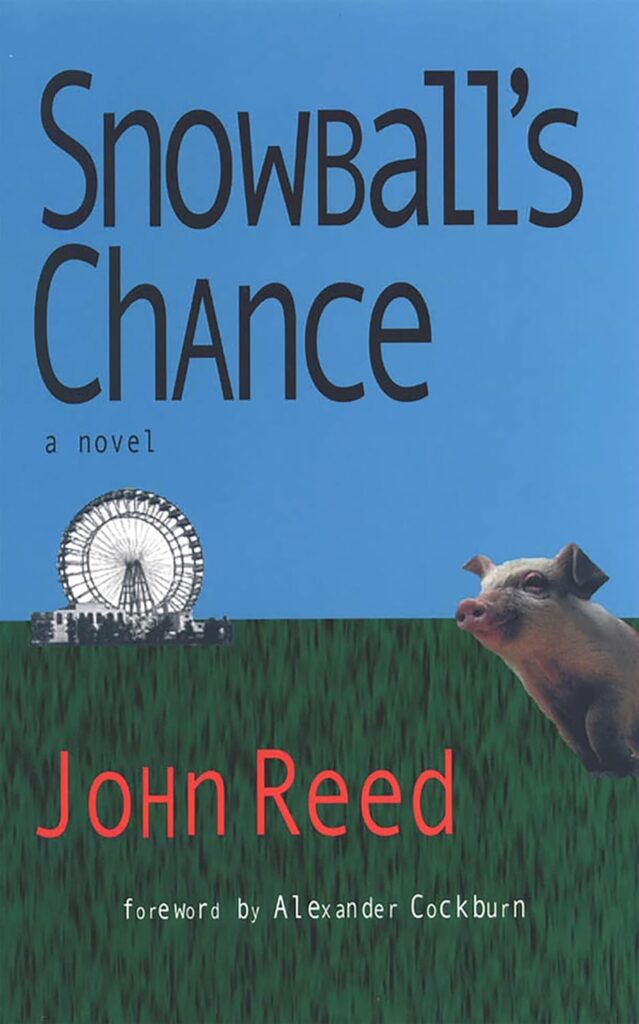
Originally published by ROOF BOOKS. Anniversary Edition published by Melville House.
- Order here!
- Order the Anniversary Edition here!
- This Podcast Will Change Your Life is a special | AWP 2024 with John Reed
- Snowball’s Chance Teacher’s Guide
- JR with Tiffany Troy | The Brooklyn Rail
- JR with Andrea Scrima | 3Quarks
- The Feeling and Fear of Inevitability | The Brooklyn Rail
- Jordan A. Rothacker in conversation with John Reed | Literary Hub
- The Rumpus: Brett Rawson in conversation with John Reed
- JR Live at the ICI with the Reanimation Library
- JR on “Snowball’s Chance” Ten Years Pt 1 | PopMatters
- JR on American Grandeur Pt 2 | PopMatters
- JR on Regrets and Snowball | WSJ
- Snowball’s Chance, Ten Years Later | Guernica
- Fiction Addiction at 2A | Electric Literature
- JR’s Fifty Books that Brainwashed Me | Big Other
- JR: Take the Shelf | Bomb Magazine
John Reed on Orwell, God, Self-Destruction and the Future of Writing
(10/18/2007)
DS: I photographed many of the New York academics who are featured in the David Horowitz book, The Professors: The 101 Most Dangerous Academics in America, and every single one of them held it up as this badge of honor. They all received emails like, “How did you get in there?” It gave them stature that they may not have had before. Is it the same?
JR: Yeah, I mean it’s just also completely so absurd. We got all this press for Snowball’s Chance, and of course it was all based on whether people were conservative or progressive. They either liked me based on their politics or didn’t like me based on their politics. Hitchens didn’t read the book. In fact, that’s the only thing that makes me a little bit bitter, that he called me a “bin Ladenist” without having read the book. But yeah, I don’t mind. It’s just so completely absurd.
DS: He coined a philosophy for a terrorist. Like ‘Trotskyite’–there never really existed this phrase “Osama bin Ladenist.” Do you think it elevated bin Laden?
JR: Yeah, it was so bizarre. He was selling Why Orwell Matters at the time. With that book they were trying to reorient Orwell away from this Cold War model. I don’t know if they can do it, really. They’ve done so much damage to his canon. I don’t know if they can shift it out of a sort of Cold War emphasis. Maybe they can. The idea that Snowball brings capitalism to the farm–we see the pitfalls there–it’s anathema to a sort of CIA model of the Cold War. But they’ve got to change it, because the Cold War is over.
The Rumpus Interview with John Reed
(06/27/2016)
The Rumpus: When I was reading through your articles, Snowball’s Chance, and thinking about political propaganda, Orwell, and Hitchens, I was struck by how we take certain words, or stories, and we literally go to war with them.
John Reed: That’s true and Hitchens was a very good example of that. And Hitchens had learned how to do it from Orwell, who had learned how to do it through the course of a real war—several real wars—and a cold war, and the subsequent involvement with the congress for ultimate freedom. Really, what was the most successful Cold War campaign against the Russians.
Orwell took a turn to the right at the end of his life, but people often apologize for that, saying he was in love with a young, beautiful woman. I think he was hopeful that he could out-maneuver the right wing bedfellows. He might have if he had survived. His environmental stance was developing, and that was another avenue for him to explore—the more progressive side of himself.
He resisted a lot of the ways that Animal Farm was being put forward, as well as 1984. Hitchens, too, I think, was under the impression that his turn to the right was something he could manage.
More than a parody of Orwell’s work, Snowball’s Chance is a cutting satire of American capitalism, exceptionalism, foreign policy, and interventionism. Playing by Orwell’s rules, Reed gives us our own farm fable, and … classic work. —Jordan A. Rothacker, Lithub
Some books double as a matchstick: if struck in the right conditions, they can cause a wildfire. … In the three weeks following 9/11, John Reed wrote a riposte to the Cold War fairy tale; the brilliance of Snowball’s Chance being that it expands upon Orwell’s parable to include terrorism, making the story a workable paradigm for the current global contexT. —Brett Rawson, The Rumpus
The novel transcends its particular circumstances … Snowball’s gambit is to turn the farm into a giant spectacle of happiness, and his Animal Fair represents more than just a place: it names an entire ethos. —Craig Epplin, Guernica
Written in lucid, wise, funny, fable-prose, this book brings to mind Spiegelman’s Maus—the use of a playful metaphor to reveal truths we might otherwise refuse to see. —Jonathan Ames
A swift and satisfying read, viciously funny. —William Georgiades, New York Post
Free John Reed! Free the piggies! —New York Press
A pig returns to the farm, thumbing his snout at Orwell … the world had a new evil to deal with, and it was not communism. —Dinitia Smith, New York Times
Orwell’s sacred pigs get a proper roast. —Paul Duchene, Portland Tribune
John Reed … is getting what he never knew he wanted, hate from right wing groups! —Daniel Robert Epstein, SuicideGirls
Reed has managed to take a dated masterpiece … and revive it for the odd, casino-like social and political world we’re mired in today; in the process he’s created his own masterpiece. —John Grooms, Creative Loafing, Charlotte
Reed’s tale, crafted amid ground zero’s dust, is chilling in its clarity and inspired in its skewering of Orwell’s stilted style. Whether you liked or loathed the original, there’s no denying Reed has captured the state of the farm today. —Jay Macdonald, Fort Myers News-Press
This book has something to upset almost everyone who reads it, just like a good book should. —Dennis Loy Johnson
A volatile new novel. —Arthur Salm, San Diego Union Tribune
The New York author has ignited a fierce literary debate; is it ever right to write a book modeled on a classic, that twists the original message into unrecognizable form? —David Robinson, Jacqui Goddard, Scotsman
Snowball’s Chance parodies Orwell’s Animal Farm, dragging it kicking and screaming into the 21st century. —Edward Nawotka, Publisher’s Weekly
[Reed] not only shanghais Orwell’s story, but amps up and mocks the writer’s famously flat, didactic style–that fairytailish simplicity that has ensured Animal Farm a place in high school English classes for the last 50 years. —John Strausbaugh, New York Press
Fearless, provocative, and both reverent and irreverent at the same time. —Robert Lopez, WordRiot
In the aftermath of September 11, 2001, ideas that had been germinating suddenly coalesced, and in three weeks’ time Reed penned a parody of George Orwell’s Animal Farm. The memorable pig Snowball would return from exile, bringing capitalism with him—thus updating the Cold War allegory by fifty-some years and pulling the rug out from underneath it. … Orwell’s writing had long been used as a propaganda tool, and evidence had emerged that his political leanings went far beyond defaming communism—but if facing this basic historical truth was so unthinkable, what was the taboo preventing us from seeing? Reed’s examination of our Orwell preoccupation sifts through the changes the West has undergone since the Cold War: its cultural crises, its military disasters, its self-deceptions and confusions, and more recently—perhaps even more troubling—its new instability of identity. —Andrea Scrima, 3Quarks